
Utility Bill Literacy
A genre that resists being read

“The form and content of the typical bill is the result of accumulated decisions made over the course of many years, rather than the product of a holistic, forward-looking process either by the individual utilities or by commissions”
—American Council for an Energy-Efficient Economy, The State of the Utility Bill (2011)
If you’ve looked at your energy bill lately, you may have noticed just how frustratingly opaque it can be. The charges are there, but the story tying them together is not. Such confusion is widespread. In fact, a 2025 survey found that fewer than half of Americans (42%) fully understood the cost drivers of their gas and electric bills, while 4 out of 5 felt powerless to control how much they were being charged (Powerlines /Ipsos, 2025). And in another survey, 59% of respondents said parts of their electric bill seemed like they were “written in another language” (Smart Energy Consumer Collaborative, 2023).
Like any genre (from Marvel movies to Shakespearean sonnets), the utility bill has a set of established conventions, and we, as utility customers, approach it with certain assumptions. We expect a bill to tell us why we are being charged a certain amount of money for using a certain amount of energy. However, the bill itself often suppresses or obscures the reasoning behind those basic outputs, leaving many customers confused, resigned, and sometimes outraged after an encounter with their bill. The strong emotions evoked by reading one’s bill are not a sign of personal failure, but the consequence of a genre that expects us to understand a system that it does not fully reveal.
This post is about becoming utility bill literate: learning how to read what appears on the bill itself, while also learning how to supply the missing context needed to understand why energy costs what it does, what we are actually paying for, and whether there might be a more affordable and equitable way to fund our shared energy systems. We’ll look at a gas bill, but the same basic principles apply to electric bills.
To fully comprehend this genre, you have to become a different kind of reader. You have to read what’s on the surface—the various components and charges—as well as what’s beneath that surface—the accumulated decisions, policies, and values that form the system that produced it. So if you feel you are not yet utility bill literate, it’s not because you are bad at reading. It’s because the system that makes your bill make sense is hard to see.
(If you’re new to Cheaper Heat, check out my first post, in which I argued that “cheap” energy is not the same as affordable energy, and subscribe below to follow along.)
The Genre of the Utility Bill
I didn’t really know how to read my gas or electric bill until three years ago. And that was only because I was working on a report about Illinois’s gas system, and my colleagues and I constantly had to distinguish between delivery and supply charges, fixed and variable charges, riders and surcharges, oh my.
If those terms are new to you, don’t worry. You’re in the majority. And if you think that when you pay your gas bill you’re mostly paying for, well, gas, you’re in the majority there too. Utility bills are not, on the whole, designed for ordinary people to easily understand, despite the many bill “explainers” you may find on a utility’s website.
As a genre, utility bills resist being read. Accurate interpretation of their many components requires a guidebook, a history lesson, and a good deal of patience. On its surface, a utility bill appears similar to a receipt: a private transaction between an individual and a company. But in reality, it does not allow such an easy one-to-one correspondence of product to price, or of person to system. Instead, the experience of reading one is more like trying to assemble an IKEA cabinet: you have the components and the instructions and yet after an hour you feel even farther away from the picture on the box (or maybe that’s just me).
If we read our utility bill like a simple receipt, we miss what these charges include: not just the price of fuel, but the infrastructure that delivers it. We also miss what it excludes: the risks and ill effects of fossil fuels that are not priced in. That lack of information matters because the perception of “cheap” energy depends on what remains hidden or obscured. Gas can look cheap if we focus only on the price of the fuel itself. But heat is only affordable if the whole bill, and by extension the whole system, is affordable.
Consumer advocates have long understood that utility bills require translation. The Illinois CUB (Citizens Utility Board) publishes a guide called “Making Sense of Your Gas Bill,” a glossary of sorts for decoding this impenetrable genre. However if your monthly bill needs this much translation, it begs the question of whether there is something about the genre itself that resists interpretation. Using this guide and the one supplied by a gas utility itself, let’s look at a sample gas bill in Illinois and see what parts of the system are visible on the page and what parts require some digging to understand.
Deciphering Your Gas Bill
Below is a sample bill for Peoples Gas in Chicago, IL, which the utility publishes on its website to instruct customers on how to interpret their charges.
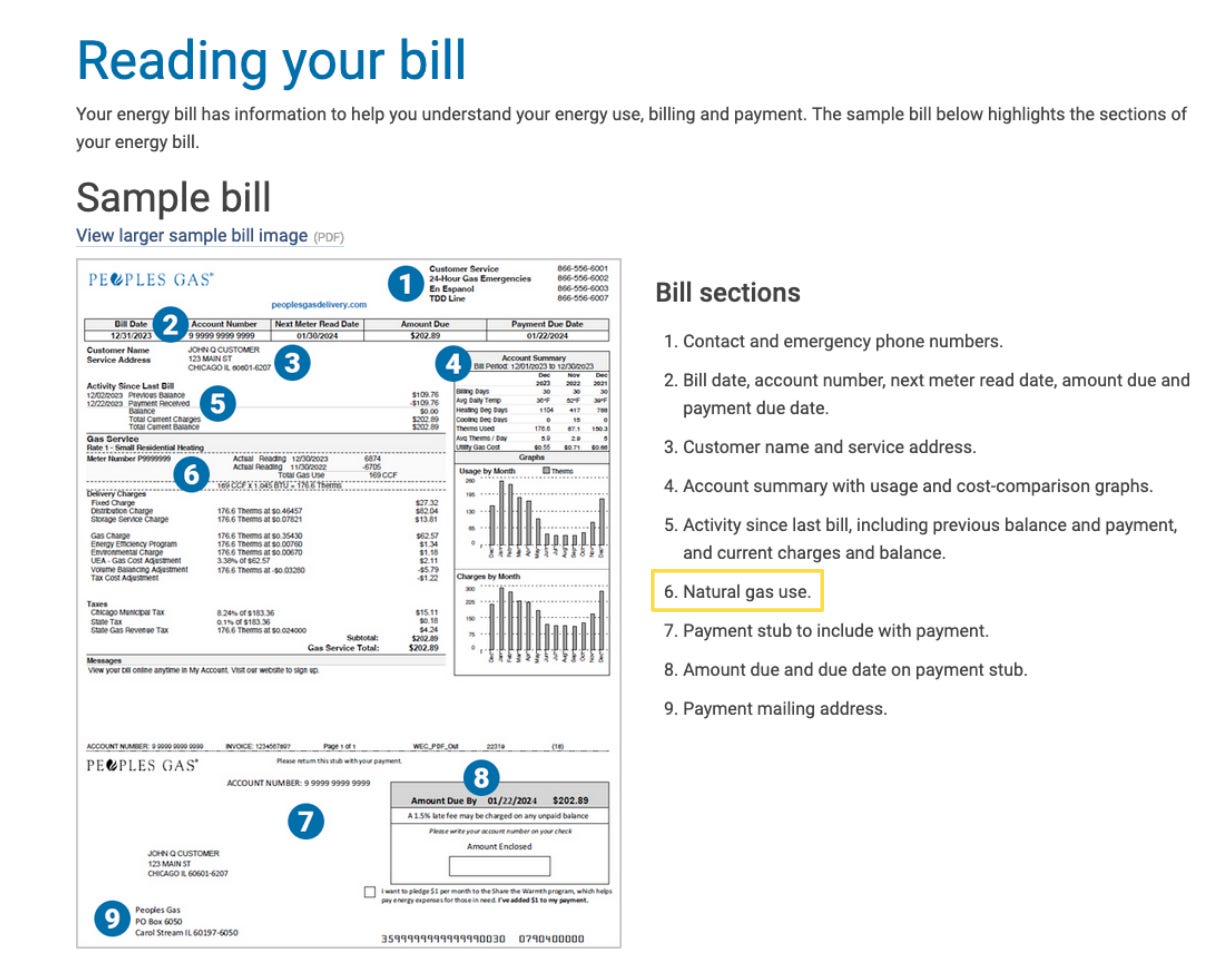
Above: An example gas bill from Peoples Gas in Chicago.
In this annotated bill (which also includes the set of definitions on the back of the bill), the most consequential part of the bill, section 6, is labeled simply as “natural gas use.” However in reality, this section includes more than what the average person would consider “natural gas use.” It includes fixed and variable delivery charges, commodity or gas charges, four separate riders or surcharges, and state and local taxes. In this example, only 30% of the total bill is for the gas itself. Some of the remaining charges rise with how much gas you use, while others are fixed or calculated in different ways. But they are not strictly about the gas itself; they are about the system that delivers it.
So let’s break down what’s hiding below the surface of “natural gas use.”
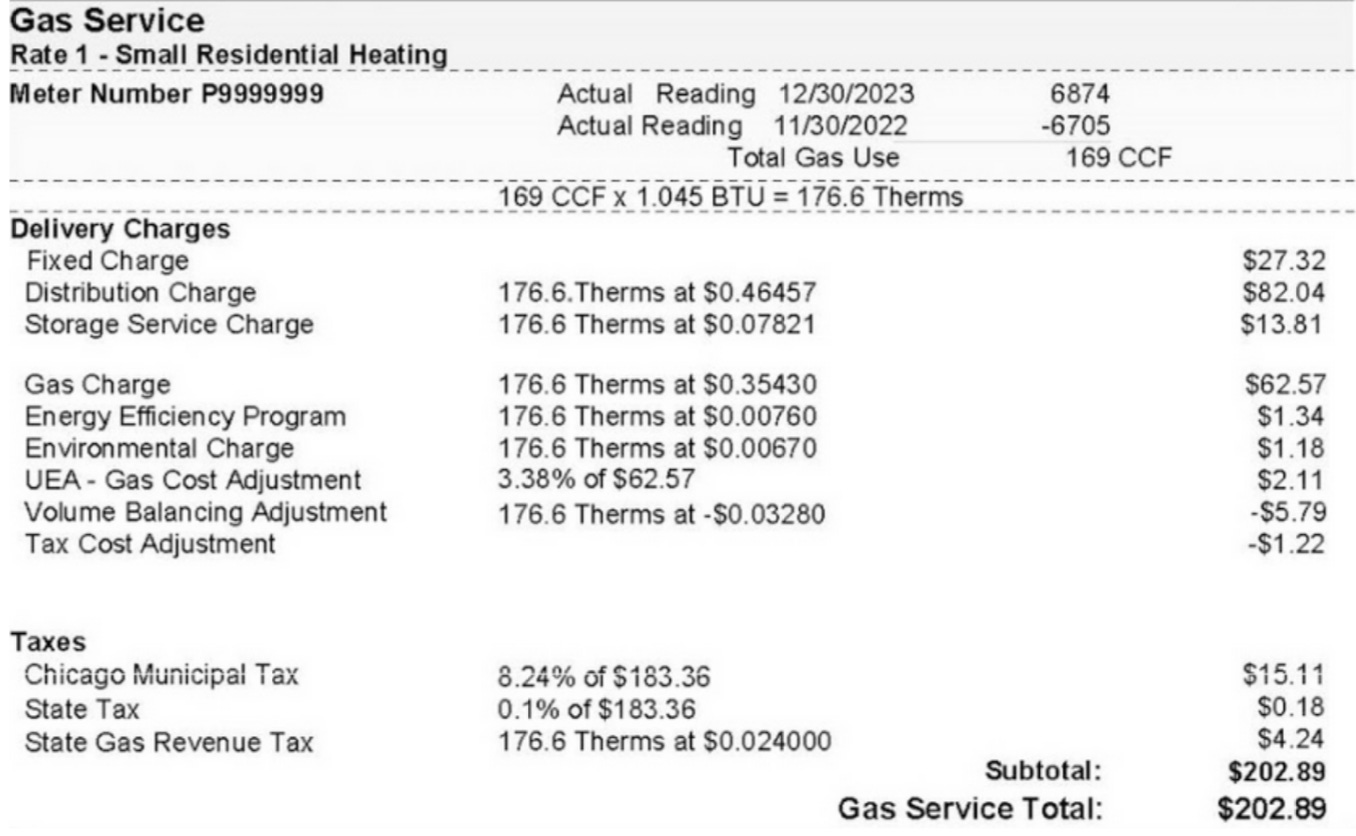
Above: A detailed look at section 6 of the example gas bill from Peoples Gas in Chicago, IL.
Delivery charges recover infrastructure costs like pipelines and meters and contain fixed and variable charges. These costs tie back to capital investments, which investor-owned utilities can earn a regulated return on. The more infrastructure utilities build, the greater the returns. (More on this in a future post.)
Fixed charges are flat monthly fees that customers pay regardless of how much gas they use. They are sometimes called “customer charges,” “account charges,” or “service charges” depending on utility. A higher share of fixed charges provides greater revenue stability for utilities, even if gas consumption declines.
For residential customers, this fixed charge can be just a few dollars a month to more than forty dollars. In the small sample of tariffs I looked at, residential customer charges ranged from $4.00 a month for Southwest Gas’s CARE (low-income) residential gas service in Southern California to $15.70 a month for residential customers of PECO Energy in Pennsylvania to $25.81 a month for Peoples Gas’s residential heating customers in Chicago. (The example bill above shows a fixed customer charge of $27.32, which reflects the tariff in effect when the sample bill was issued.) Enbridge Gas Ohio’s “basic service charge” was the highest I found, with a whopping $43.43 monthly charge for residential customers.
Variable charges (“distribution charge” and “storage service charge” on the bill above) are based on usage and are calculated per therm of gas that your household consumes.
The supply charge (“gas charge” on the bill above) pays for the gas itself. This is the part of the bill most directly tied to the market price of gas, which can fluctuate month to month and season to season, and is what most people assume they are paying for when they pay their bill. These are “pass-through” costs, meaning utilities do not earn a profit on them.
The bill above is extra confusing because it has two bold headers—Delivery Charges and Taxes but also a paragraph break right above “Gas Charge” without a new bold header to define it. This design feature adds confusion for the reader—is my gas charge part of the delivery charge section? Is it a new section? How does it relate to the charges below it, grouped together in the same “paragraph”?
Riders and surcharges are charges (Energy Efficiency, Environmental Charge, UEA charge on this bill) tied to specific costs or programs that regulators allow utilities to collect separately from base delivery rates. Some pay for energy efficiency programs, environmental cleanup from past gas operations, low-income discounts, or other public programs. Others recover infrastructure costs, including accelerated pipeline replacement. Some riders allow utilities to recover costs between full rate cases, which means your bill can change even when the utility has not gone through a complete rate-setting process.
Riders and surcharges help hide the system in plain sight. Though they are often only a few cents or a few dollars a month, they represent critical policy and infrastructure decisions. A small charge on one bill can translate into a vast pool of money for utility investments when it’s collected from hundreds of thousands of customers. This does not mean every rider is bad. But it does mean riders deserve scrutiny. For example, an “energy efficiency” charge may sound benign, but if it funds more efficient gas appliances, it is worth asking whether ratepayer money should continue improving the performance of a fossil fuel system we increasingly need to shrink. Why charge customers for programs that replace a 97% efficient gas water heater with a 98% efficient gas water heater, when a heat pump water heater can be three times as efficient as the most efficient water heater?
Finally, every bill contains taxes and fees, typically from state or local governments and passed through to customers by the utility. They may include state utility taxes, municipal taxes, franchise fees, or other local charges. Like riders and surcharges, they are not charges for gas itself. They are part of the larger set of costs that get attached to energy service before the final amount due arrives in your inbox.
You can see why “natural gas use” is an incredibly misleading label for this entire section. It gives the impression that you are paying mainly for the gas you used to heat your home, when reading beneath the bill tells a different story. Electric bills look a bit different, but the same basic lesson applies. You pay for the electricity itself, but you also pay for the poles, wires, substations, meters, customer service, grid maintenance, public programs, taxes, and other utility investments that make electric service possible. The difference is that every home needs electricity, while methane gas can be replaced. That difference matters because maintaining both systems is part of what is making heat unaffordable.
Note: I’m using the 2023 example because the newer 2026 example bill is less representative of a typical winter heating bill. It shows a January bill with only 72 therms of usage and a total of $117—which is not even close to what a household would use to heat in the winter. Many utilities use around 175 therms as the average heating load in the winter. It may seem like a small oversight, but if we are giving customers examples to read, we should ensure they are as accurate and representative as possible, not misleading to make the overall cost of heat look artificially lower than it is.
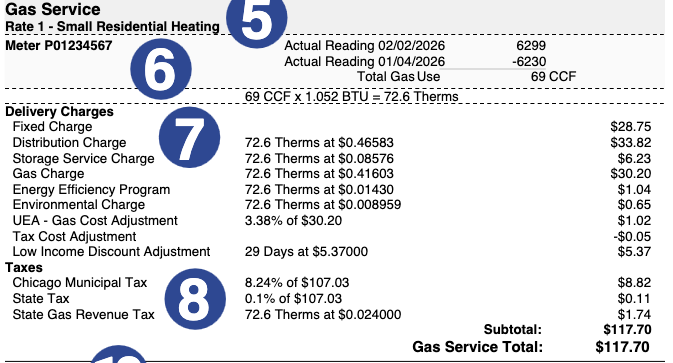
Above: A misleading 2026 example bill from Peoples Gas, which makes it look like winter gas bills are way cheaper than they actually are.
Becoming Bill Literate
The first step toward becoming bill literate is understanding that your energy bill is not just a receipt for the gas or electricity you used. It is a monthly payment into complex, expensive, regulated infrastructure systems. And that is why cheap fuel does not necessarily mean affordable heat. Affordability depends on the whole system, which is connected to a web of local, state, national, and global policies that, over the years, have led to an entrenched way of doing things—not all of which are in customers’ or the public’s best interest.
The second step toward becoming bill literate is demanding a more holistic, purposeful approach to utility bills—one that goes beyond the cursory “bill explainers” or a key on the back of the bill. An individual should not be burdened with the need to become an expert in utility finance just to understand what they’re paying for and why. As written today, utility bills make the accumulated history of policies, investments, and decisions look like neutral line items, obscuring the link between this system and the customers who often feel disconnected from it.
In the next post, I’ll continue this quest for bill literacy by addressing more of what’s beneath the bill: the buried pipes, regulatory decisions, and perverse incentives that will drive household costs for decades to come.