
Intimate Atmospheres
The pollution inside our homes

“Atmosphere is an invisible backdrop of everyday life, and yet nothing is more consequential.”
—Hsuan Hsu, Air Conditioning (2024)
Atmosphere isn’t just something that passively exists “out there,” but something we actively and collectively produce through infrastructures, fuels, technologies, policies, and habits. Every plane ride, every drive, every appliance, and every breath we breathe participates in the making of our shared air. But not every activity affects the atmosphere equally, and not everyone has equal power over the air they breathe.
This final post in my mini-series on the gas system’s geographies of risk explores how the hidden costs of this system affect both our shared and intimate atmospheres. It’s about how pollution from the methane gas system is compressed, concentrated, and enclosed in the spaces where we cook, eat, sleep, and breathe. And how even though we often speak as if we all share the same air, the air you actually breathe is differentiated by things like the size of your home, where you live, your credit score, whether you rent or own, how much money you make, your race, and many other social and material conditions.
We spend 90% of our lives indoors. Our health and quality of life are not only shaped by the pollution outside our homes, but also by the quality of the air inside them. And while the burdens of burning gas may not be immediately apparent, they accumulate in these intimate atmospheres day after day, disproportionately affecting those with the least ability to measure, mitigate, or escape them.
Gas Appliance Pollution
After fracked gas travels through transmission and distribution pipes, it branches off into service lines that connect distribution mains to individual buildings. Nearly 75 million U.S. homes use methane gas to heat their homes or water, or to cook their food. While gas water heaters, furnaces, and dryers contribute to air pollution and climate emissions, the appliance that has the most direct effect on indoor air quality is the gas stove, which directly pollutes the rooms where people spend the majority of their time.
Gas stoves emit many hazardous air pollutants. Some of the worst offenders include nitrogen dioxide (NO2), benzene (C6H6), carbon monoxide (CO), formaldehyde (H2CO), and ultrafine particles, all of which negatively affect air quality and health. The most prominent and problematic pollutant among these is nitrogen dioxide, or NO₂, which aggravates breathing and respiratory conditions like asthma. Children are especially vulnerable to nitrogen dioxide: a recent study estimated that about 50,000 childhood asthma cases in the U.S. are attributable to long-term NO₂ exposure from gas stoves. A separate national analysis estimated that 12.7% of current childhood asthma in the U.S. is attributable to gas stove use, with higher state-level estimates in places such as Illinois, California, New York, Massachusetts, and Pennsylvania.
Despite this evidence of ill effects, there is currently no federal indoor air quality standard for NO₂, even though outdoor NO₂ levels are regulated. Studies have found that cooking with gas causes NO₂ to exceed “acceptable” levels for outdoor air standards, especially when gas stoves are used without ventilation. One Lawrence Berkeley National Lab modeling study estimated that 62% of homes regularly exceeded health-based outdoor air standards for NO₂. Since indoor air is much more concentrated and static than outdoor air, we can assume that if indoor standards existed, they would have a lower tolerance for NO₂ than outdoor air.
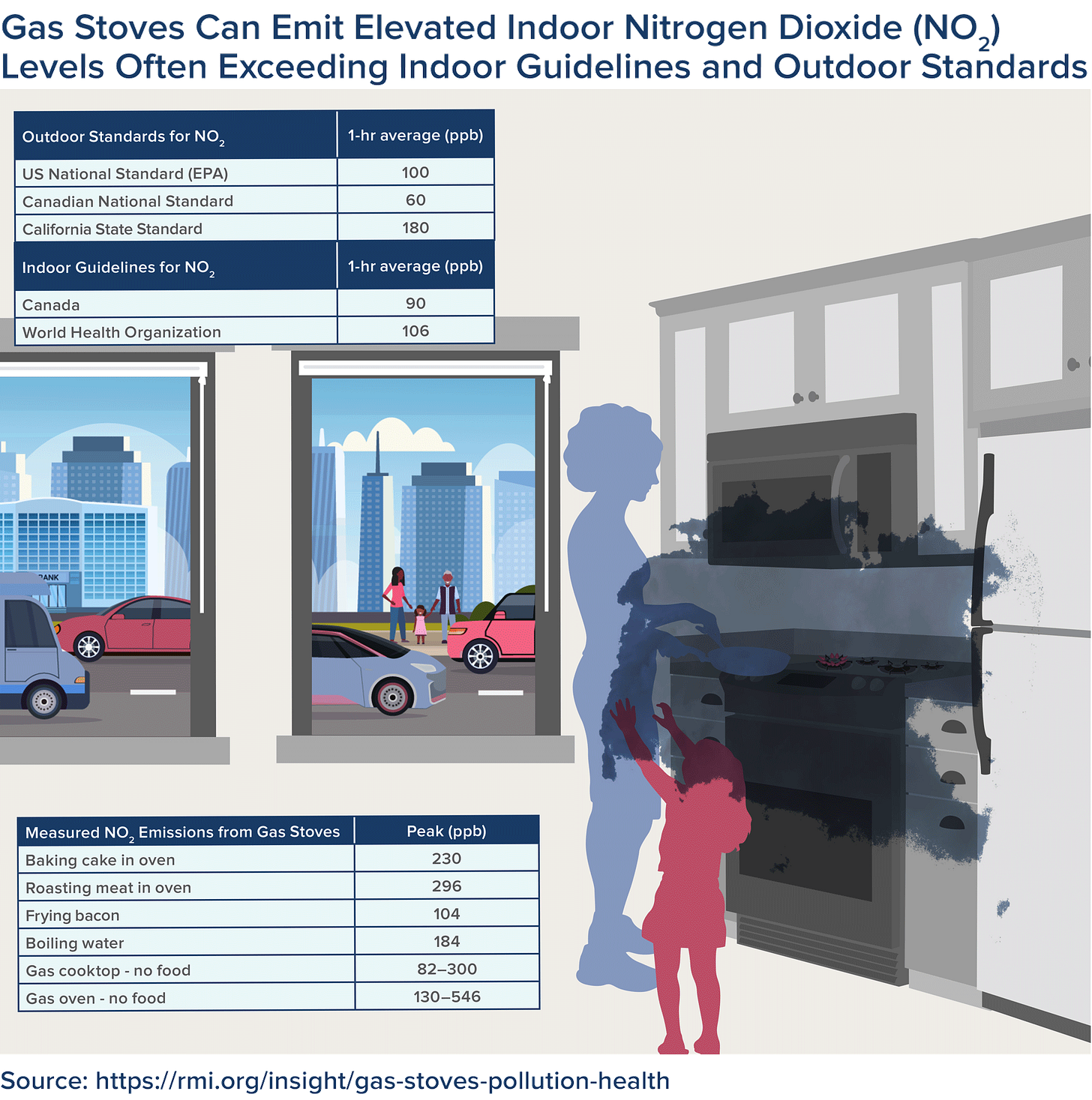
What is perhaps even more troubling than a gas stove emitting hazardous pollutants while it’s on and actively combusting gas, is the fact that many gas stoves leak gas when they’re off. A Stanford study found that more than three-quarters of methane emissions from gas stoves occurred while the stoves were off, suggesting that fittings and connections between stoves and in-home gas pipes are responsible for much of these emissions. And so, “simply owning a natural gas stove and having natural gas pipes and fittings in your home leads to more emissions over 24 hours than the amount emitted while the burners are on,” says Stanford professor of earth sciences Rob Jackson, one of the study’s authors (NPR).
The risks of combustion are not confined to the inside of buildings. While stoves offer the most intimate and immediate example of these effects, furnaces, boilers, and water heaters also burn gas across millions of homes and businesses, contributing to outdoor air pollution as well as climate-warming emissions. A Harvard study measured the effects of outdoor PM2.5 pollution from gas appliances, which is particularly dangerous because the microscopic particles can infiltrate the lungs and bloodstream, causing a host of health problems. It found that the combustion of gas, biomass, and wood in residential and commercial buildings has surpassed coal combustion as a major source of health harms from stationary-source air pollution. Specifically, it found that “commercial and residential buildings are now responsible for approximately 18,300 early deaths and $205 billion in health impacts—one-third of the health burden from stationary sources in the United States” (RMI).
Inequitable Atmospheres
Gas combustion intensifies the risk-distribution pattern that connects extraction, peaker plants, and leaking pipes. The infrastructure of the gas system, and the risks it carries, permeate even the most intimate and ordinary parts of daily life through the air we breathe, the food we cook, and the rooms we consider safe and separate from the outside world. And not all households are equally equipped to mitigate these risks. While affluent homeowners may be able to replace appliances, install high-quality ventilation, or remodel their kitchens, low-income homeowners, renters, or households that do not have affordable access to financing have few options for improving their air quality.
A Stanford/PSE Healthy Energy study confirmed that gas stove pollution does not affect all households equally. It found that because lower-income families are more likely to live in smaller homes, NO₂ from cooking can build up more quickly compared to higher-income households, which are more likely to live in larger homes with correspondingly lower NO₂ concentrations. The same study found that Indigenous/Alaska Native households experience the highest long-term NO₂ exposure from gas or propane cooking, about 60% above the national average, while Hispanic/Latino and Black households experience about 20% higher long-term exposure than the national average.
In order to equip these disproportionately affected communities with the tools they need to take action, it’s necessary to make this pollution legible on a home-by-home basis. While people may have their own personal record of health issues, they may not be able to link those symptoms to their gas appliances without the tools that can measure this “invisible” pollution and make it externally legible.
Community-Centered Science
If scientific studies establish the health risks of gas combustion, citizen science shows how those risks become visible to the people living with them. When community-led researchers bring air-quality monitors into the kitchens, basements, and living rooms of their community members, the abstract problem of emissions crystallizes into something personal and urgent. These projects do more than collect data; they help residents see the air in their own homes differently and connect their own lived experiences to the effects of their gas appliances. They then teach these households how they can use this newfound knowledge to minimize their exposure and improve their quality of life.
That is exactly what a 2024 citizen science study conducted by the Beyond Gas coalition found when it tested 700 kitchens in the District of Columbia and Maryland for nitrogen dioxide. Nearly two-thirds exceeded the Environmental Protection Agency’s (EPA’s) health standard for safe outdoor exposure to nitrogen dioxide. Furthermore, in a third of the homes tested, nitrogen dioxide levels were even higher 15 minutes after the stove had been turned off compared to when it was on, suggesting that indoor air pollution intensifies as it lingers after cooking has ended (Beyond Gas DC, 11).
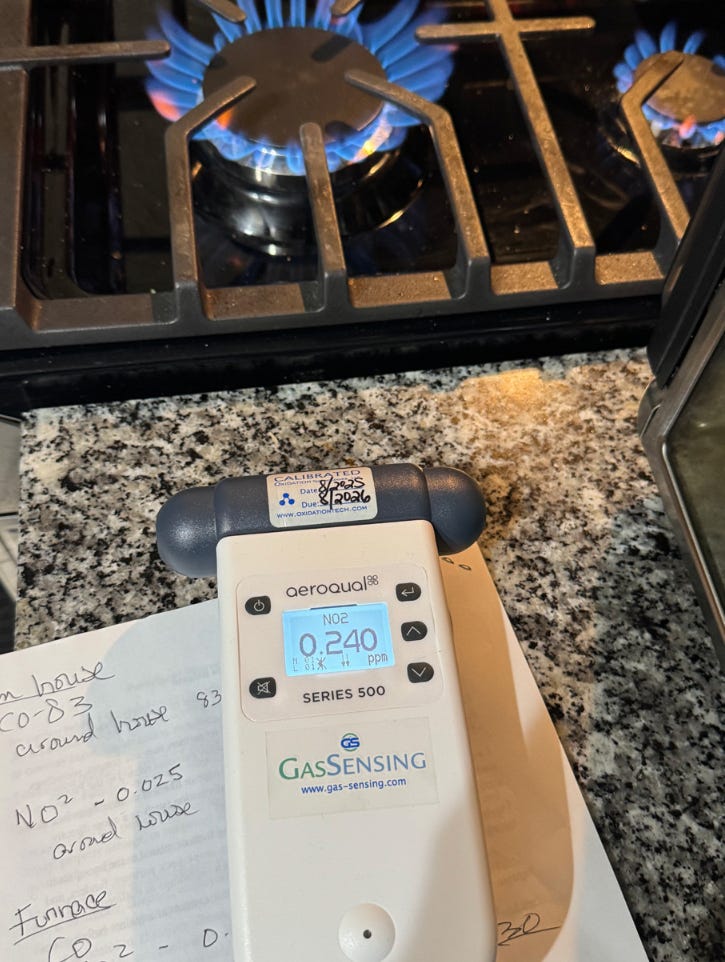
Above: Photograph of a volunteer testing nitrogen oxide levels while the gas stove is on in a home in Chicago. Source: AirAware: The People Powered-Search for Healthier Air.
A newly released study conducted in Chicago by the organization Faith in Place measured carbon monoxide levels around gas-burning equipment and heating points such as furnaces, dryers, water heaters, and heating vents as well as nitrogen dioxide levels during and after gas stove use in 101 homes across Chicago. In the vicinity of gas appliances that were passively “on” (such as a water heat with a pilot light), they found that nearly 80% of the homes tested had carbon monoxide levels at or above 4 ppm (the World Health Organization 24-hour guideline), and just over half of the homes reached carbon monoxide levels that exceeded 9 ppm. Similar to the Stanford study that found gas stoves leaked while off, this study provides evidence of the active pollution caused by gas appliances even when they’re on “standby” mode.
To measure gas stove pollution specifically, the citizen scientists tested air quality after turning two gas burners on for 30 minutes, but without cooking any food, in order to respond to opposition claiming that air quality issues are due mainly to PM 2.5 pollution caused by food particles themselves, not gas combustion. They found that 55% of kitchens recorded nitrogen oxide levels of at least 100 ppb, which is the EPA’s outdoor air quality standard. However, many kitchens reached levels much higher than this—40% reached more than 200 ppb while 30% exceeded 500 ppb (AirAware, 9). In addition, some households opted to have other rooms tested 30 to 45 minutes after the stove had been on—living rooms, bedrooms (upstairs and on the same level as the kitchen), and offices—and nitrogen dioxide was detected in all of the rooms (AirAware, 5). This study was especially relevant given that an earlier 2019 study had found that over half of lower-income Chicago homeowners reported using the stove or oven for heat, staying in only certain rooms or leaving home to manage utility costs.
Importantly, these projects did not only measure pollution, but changed how people understand their homes and the air within them. By ending each house visit with knowledge- and resource-sharing, the AirAware Chicago study helped households mitigate their air pollution and learn about how to access electric alternatives to gas stoves. The testing results changed how households thought about their gas-burning equipment and how they understood certain health problems like asthma and their connection to gas appliance pollution. Rather than just identifying the risks lurking inside of people’s homes, these community-led efforts gave residents tools to turn their fear and anxiety into action while also demonstrating how the seemingly distant risks of the gas system are quite near.
Collective Atmospheres
The atmosphere produced through gas combustion is at once intimate, private, public, and collective. Tracing methane gas from the site of extraction to gas-burning appliances demonstrates how the gas system delivers heat while organizing exposure to risk. At each stage, the system requires different people and places to absorb different risks: contamination near fracking wells, polluted air near peaker plants, methane leaks from pipes, and asthma-causing combustion inside homes. These harms may look separate when we examine them one at a time, but when viewed as interconnected parts of the gas system, they reveal the larger pattern: the system relocates risk and defers costs so that heat can appear cheap and reliable, while forcing certain communities and households to absorb the excess costs of extraction, generation, delivery, and combustion. And study after study demonstrates that the people who have the most risk shifted onto them are disadvantaged communities, low-income households, and people of color.
To make heat truly affordable, clean, and just, we have to stop treating risk as something to be relocated and start seeing the system as a whole, and the people connected to it as a collective. The goal is not to secure cheap heat for some by distributing harm to many others, but to redesign the systems that deliver heat so that safety, affordability, and comfort are shared rather than dependent upon someone else’s exposure to harm.